

Your SaaS is not a magical portal where users appear, swipe their cards, and stay forever. It is more like a gym membership: people join with enthusiasm, vanish after week two, and blame the treadmill.
SaaS marketing steps in as the friendly coach who hands them the right plan, checks in often, and keeps them proud of every tiny win. With the right system, you do not chase customers; you guide them.
By the end of this guide, your subscription product will stop feeling like a secret hobby project and start behaving like a reliable, growing business.
What is SaaS Marketing?
SaaS marketing is the process of attracting, converting, and retaining users for subscription-based software products delivered through the cloud.
SaaS stands for software as a service. SaaS marketing is the process of attracting, converting, and retaining users for subscription-based software products that live in the cloud. Instead of pushing a one-time purchase, it focuses on recurring revenue, upgrades, and long-term relationships with customers.
SaaS makes sure people hear about your tool, try it, understand the value quickly, and keep paying for it every month. Slack, HubSpot, and Dropbox all depend on software as a service marketing to move people from curiosity to free trials and then to paid plans. Because users can cancel at any time, SaaS has to keep proving value across the whole customer journey, not just before the first sale.
Traditional product campaigns usually talk about features and price, and then stop after purchase. Software-as-a-service marketing cannot stop there, because churn turns into a silent revenue leak. That is why software as a service marketing covers awareness, onboarding, product education, expansion, and advocacy under one connected growth system. Done right, SaaS makes your product the obvious choice today and the easy habit tomorrow.
Key SaaS Marketing Strategies
SaaS marketing strategies focus on getting the right users, helping them succeed early, and retaining them to grow recurring revenue.
Software as a service marketing relies on proven approaches that drive trials, conversions, and retention. Each strategy targets a specific stage of the customer journey. Teams build these tactics around data and user behavior for steady growth. Below, each one breaks down into clear steps and examples.
1. Ideal Customer Profile and Buyer Personas
An ideal customer profile helps SaaS companies target users who are most likely to buy, stay, and succeed with the product.
Software as a service marketing (SaaS) begins with sharp targeting. Teams define the ideal customer profile (ICP) first. They list traits like company size, industry, and role. Next, they create buyer personas. These profiles name typical users, such as “Marketing Manager Sarah,” who struggles with lead tracking.
Why it works: Random traffic wastes budget. Precise profiles focus efforts. For instance, a CRM tool targets mid-sized e-commerce firms. It skips enterprises with complex needs. Teams map pains like “manual data entry eats hours.” Then, they craft messages that hit those pains.
Action steps:
- Survey current customers for common traits.
- Interview sales teams on who closes fastest.
- Build 2-3 personas with names, goals, and blockers.
- Align all content and ads to these profiles.
This foundation makes every dollar in software-as-a-service marketing count. Traffic converts better when it matches the right fit.
2. Content Marketing and SEO
Content marketing helps SaaS companies attract high-intent users through helpful articles that solve real problems.
Strong content forms the core of SaaS. Blogs, guides, and videos draw organic traffic. Over 50% of SaaS site visits come from these sources. Prospects search for solutions. Content answers their questions while showcasing the product.
Examples include “How to automate email campaigns” guides. They solve real problems. A subtle product demo follows. Comparison pages rank high, too, like “Tool A vs Tool B for analytics.”
Build it right:
- Target high-intent keywords like “best CRM for startups.”
- Publish weekly with 1,500+ words per post.
- Add visuals, templates, and checklists.
- Link to free trials at the end.
SEO compounds over time. SaaS marketing turns search engines into a free sales team. Visitors arrive ready to test the product.
3. Free Trials and Freemium Models
Free trials let users experience value before paying, which increases trust and conversion rates.
SaaS marketing removes signup barriers. Free trials let users test the value firsthand. Freemium plans offer core features for free. Upgrades unlock more power. This approach beats hard sells.
Dropbox grew famous with referral freemium. Users got extra space for invites. Onboarding flows guide next steps. Checklists say “Connect your email” or “Invite your team.”
Key tactics:
- Limit trials to 14-30 days.
- Highlight quick wins in the first login.
- Use in-app tours for feature discovery.
- Gate advanced tools behind paid walls.
The “aha moment” seals the deal. Users feel success fast. SaaS marketing bridges signup to value seamlessly.
4. Onboarding Flows and In-App Guidance
Onboarding helps new users understand the product quickly and reach their first success.
Once inside, software as a service marketing focuses on activation. Onboarding turns signups into users. Flows include checklists, tooltips, and progress bars. They lead to first wins.
Take Slack. New teams add channels and invite members step-by-step. Prompts celebrate “Your first message sent!” This builds a habit.
Make it effective:
- Personalize based on signup source.
- Track completion rates daily.
- Add video walkthroughs for complex setups.
- Trigger support chats at stuck points.
Poor onboarding kills retention. Great software as a service marketing makes products intuitive from day one.
5. Lifecycle Emails and CRM Automation
Lifecycle emails guide users based on behavior, not guesswork.
SaaS marketing nurtures with smart emails. Tools like HubSpot or Intercom send behavior-based messages. A user skips setup? Get a nudge email. They use a feature thrice? See an upgrade tip.
Avoid blasts. Triggers beat schedules:
- Day 1: Welcome with a quickstart video.
- Inactive 3 days: “Need help getting started?”
- High usage: “Unlock team features now.”
Results show 6x higher opens. Users feel supported. SaaS marketing builds trust without pushiness.
6. Paid Media with Tight Targeting
Paid ads work best in SaaS when they target specific roles and high-intent searches.
Paid ads fuel software as a service marketing scale. Google Search captures intent. LinkedIn hits decision-makers. Retargeting reminds cart abandoners.
Unlike e-commerce, SaaS chases quality. Bid on “CRM for solopreneurs.” Target job titles like “Growth Marketer.”
Optimize over time:
- Start with $50 daily tests.
- Track trial starts per channel.
- Scale winners; cut losers.
- Use lookalikes from top customers.
Data shifts budgets. Lifetime value guides spending. Ads become a predictable growth lever.
These strategies interconnect. Personas shape content. Trials feed email flows. Metrics refine paid spend. Software as a service marketing creates a flywheel for revenue.
Read Next:
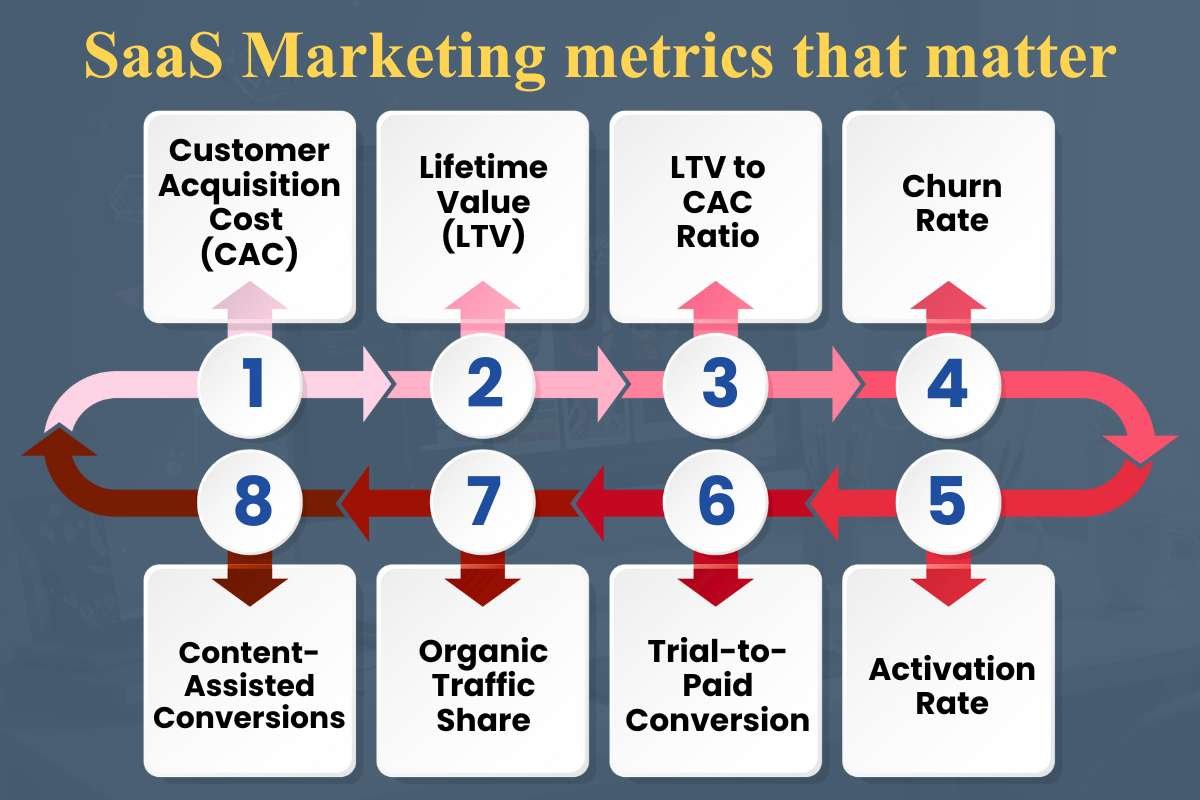
SaaS Marketing metrics that matter
Software as a service marketing metrics reveal the health of subscription businesses. These numbers guide decisions on spending, growth, and retention. Teams track them closely to spot issues early and act fast.
1. Customer Acquisition Cost (CAC)
CAC calculates the total spend to land one new paying customer. Add up marketing ads, sales salaries, tools, and content costs. Divide by the new customers gained in that period.
Why it matters: High CAC drains cash fast in software-as-a-service marketing. It shows if channels waste budget on the wrong audiences. Founders watch this to balance growth speed with runway.
How to calculate:
- Marketing CAC = Ad spend + content tools ÷ new customers from marketing.
- Sales CAC = Salaries + commissions ÷ customers closed by sales.
- Total CAC blends both for the full picture.
Example: A team spends $50,000 on ads and hires. They gain 100 customers. CAC equals $500 each. If prices start at $50/month, recovery takes 10 months, too slow for most.
Action steps: Lower CAC by refining target profiles. Test LinkedIn over broad Google ads. Double down on organic content that converts without paid boosts.
2. Lifetime Value (LTV)
LTV predicts total revenue from one customer over time. Multiply average revenue per user by months retained. Subtract servicing costs for net value.
Why it matters: LTV fuels bold SaaS marketing bets. High LTV justifies bigger ad spends or sales hires. It offsets churn risks in subscription models.
How to calculate:
- LTV = (Average monthly revenue per customer × gross margin) ÷ churn rate.
- Simple version: Monthly fee × average lifespan in months.
Example: Customers pay $100/month. They stay 24 months on average. Gross margin hits 80%. LTV equals $1,920. This supports CAC up to $640 for a 3:1 ratio.
Action steps: Boost LTV with upsells and expansions. Send usage-based offers. Cut churn through better onboarding. Track cohort retention monthly.
3. LTV to CAC Ratio
This ratio compares customer value to acquisition cost. Aim for 3:1 or higher in B2B software as a service marketing. Below 1:1 spells danger.
Why it matters: The ratio proves sustainable growth. It tells investors if the model scales. SaaS marketing pivots fail without this balance.
Benchmarks:
- 1:1 = Break even, no profit room.
- 3:1 = Healthy for mature teams.
- 5:1+ = Excellent, frees cash for innovation.
Example: LTV at $3,000, CAC at $1,000 = 3:1 ratio. Green light for expansion. Drop to 1.5:1? Slash low-ROI channels fast.
Action steps: Raise the ratio by cutting CAC or growing LTV. Audit every dollar spent. Segment by channel for precise fixes.
4. Churn Rate
Churn tracks customers who leave each month. Divide cancellations by starting customers. Even 5% monthly compound to a 46% yearly loss.
Why it matters: Churn kills software as a service marketing dreams. It erases acquisition wins. Rising churn flags a bad fit, weak value, or poor support.
Types to track:
- Revenue churn: Dollar value lost.
- Customer churn: Headcount lost.
- Net revenue churn: Accounts for expansions.
Example: 1,000 customers start the month. 50 canceled. Churn = 5%. Fix by surveying exits. Common culprits: complex onboarding or unused features.
Action steps: Tighten targeting upfront. Add in-app guides. Assign success managers to at-risk users. Reactivate lapsed with win-back emails.
5. Activation Rate
Activation measures signups who hit a key “aha” moment. Define it per product: first task done, team invite sent, or data imported.
Why it matters: Activation predicts retention in SaaS marketing. Users who succeed early stick around. Low rates mean trials flop.
How to define:
- Project tool: “Created board + added 3 tasks.”
- Email app: “Sent campaign to 100+ contacts.”
- CRM: “Imported leads + scheduled call.”
Example: 1,000 trials start. 300 hit activation. Rate = 30%. Boost with checklists, tooltips, or demo videos at signup.
Action steps: Map user journey. Trigger emails at stuck points. A/B test onboarding flows. Celebrate activation with badges or unlocks.
6. Trial-to-Paid Conversion
This tracks free users who upgrade to paid. Divide paid starts by trial starts. Healthy range: 15-25% for B2B tools.
- Why it matters: Conversion proves SaaS + product synergy. Low numbers signal unclear value or pricing friction.
- Example: 500 trials, 100 upgrades = 20% rate. Stagnant? Shorten trials for some, extend for others. Add urgency timers or feature teasers.
- Action steps: Optimize pricing pages with social proof. Use in-app nudges at peak usage. Offer discounts to high-engagement triers.
7. Organic Traffic Share
Organic share shows the unpaid search traffic percentage. Blogs drive 53% of visits for many SaaS sites.
- Why it matters: High organic lowers CAC long-term. Content becomes SaaS marketing’s free engine.
- Example: 10,000 monthly visits, 5,300 organic = 53%. Track via Google Analytics. Feed top pages into email funnels.
- Action steps: Build keyword clusters around pains. Refresh old content. Link internally for authority flow.
8. Content-Assisted Conversions
These count sales influenced by blogs or guides. Tag UTM sources to measure.
- Why it matters: Proves content ROI in SaaS. Guides justify bigger writing budgets.
- Example: 200 paid users from blog paths vs. 50 direct. Content wins. Amplify with guest posts or repurposed videos.
- Action steps: Score leads by content consumed. Nurture heavy readers faster. Audit for conversion gaps.
Advanced SaaS Marketing tactics

As markets get crowded, software as a service marketing moves beyond basic channels into advanced, often more personalized tactics. Account-based marketing (ABM) targets specific high-value companies with tailored campaigns, custom content, and sales outreach. Instead of chasing thousands of random leads, SaaS marketing teams focus on a defined list of accounts that match their dream customer profile.
Product-led growth (PLG) deepens the link between product usage and acquisition. Here, software as a service marketing works closely with product teams to design in-app prompts, shareable features, and upgrade paths that feel natural. For example, a collaboration tool might lock advanced admin controls behind a paid tier but let teams feel the benefit during the trial. Upsell and cross-sell flows are timed with usage signals, so offers land when people already feel value.
Community building has become a powerful extension of SaaS. Many platforms host Slack or Discord groups, user forums, and customer councils where power users share tips and workflows. These communities double as feedback loops and word-of-mouth engines, since happy members often refer peers for similar needs.
Data-driven experimentation takes SaaS from guesswork to predictable growth. Teams run A/B tests on pricing pages, upgrade prompts, and onboarding emails to push small lifts in conversion rates that compound over time. AI-powered tools now help the SaaS marketing segment audiences, personalize outreach, and predict churn risks earlier, which lets teams respond before revenue slips.
Done well, advanced SaaS tactics do not make the experience feel more “marketed to.” Instead, they make the product feel more helpful, more timely, and more aligned with each user’s real context.
Read Next: Digital Vs. SaaS Marketing Agencies: How to Pick the Right Agency for Explosive Growth?
Facts and stats
- More than 50% of revenue at many SaaS companies goes toward sales and marketing costs, showing how central software as a service marketing is to growth planning.
- Around 53% of traffic to SaaS websites comes from blogs, which highlights the role of content-driven software as a service marketing in acquisition.
- The B2B SaaS market was valued at about 327.74 billion dollars in 2024 and is projected to reach roughly 1,088.15 billion dollars by 2032, with an estimated CAGR of 18.7%.
- The global AI SaaS market is estimated at about 101.73 billion dollars in 2025 and expected to grow at a CAGR above 39% through 2032, which will influence how SaaS marketing uses automation and personalization.
- By 2025, companies are projected to spend over 20 billion dollars yearly on tools such as marketing automation, CRM, and email marketing, directly supporting SaaS operations.
Conclusion
Your SaaS still will not turn into a magical money portal, but it can stop behaving like a ghost town with a great product no one understands. The same way a good coach designs clear steps and celebrates small wins, strong SaaS marketing guides the right users toward value and keeps them coming back. When strategy, product, and data line up, each new trial feels less like a gamble and more like the start of a long, healthy membership.
FAQs
1. Why is retention more important than quick sales in SaaS?
Retention builds steady revenue and lowers growth costs over time.
2. Do free trials always work?
They work best when onboarding shows value fast and clearly.
3. How long does it take to see results?
Most brands see steady improvement within three to six months.
4. Is content still effective for software brands?
Yes. Helpful content builds trust and authority consistently.
5. Can small teams run effective SaaS growth plans?
Yes. Focused strategy matters more than team size